Everyday spending
How to Stop Overspending on Groceries
The practical answer
To understand grocery overspending, count the whole shopping cycle: the main shop, smaller top-ups and delivery fees. Check usable food at home, plan the meals you need, then price whole packs before shopping. Compare the plan with every receipt and adjust one repeat problem at a time while protecting adequate food and dietary needs.
Define what your grocery number includes
Choose a clear period, such as the days until the next shop. Decide whether household supplies, delivery fees and takeaway meals belong in this category or elsewhere. Be consistent so your comparison means something.
Add small trips as well as the main receipt. A shop that appears to cost 80 MU may actually use 100 MU once a top-up and delivery fee are included. Start with what your records show rather than a target borrowed from a different household.
Plan meal coverage from usable food
Check your cupboards, fridge and freezer, then mark food to use first. Count the meals you need to cover around work, school and other commitments. Food already at home helps only if it is usable and fits a meal you can actually prepare.
Account for allergies, medical diets, storage and kitchen access. A cheaper item is not a saving if it cannot meet your needs. This is a budgeting exercise, not a nutrition plan or a reason to cut adequate food.
Price the packs you will buy
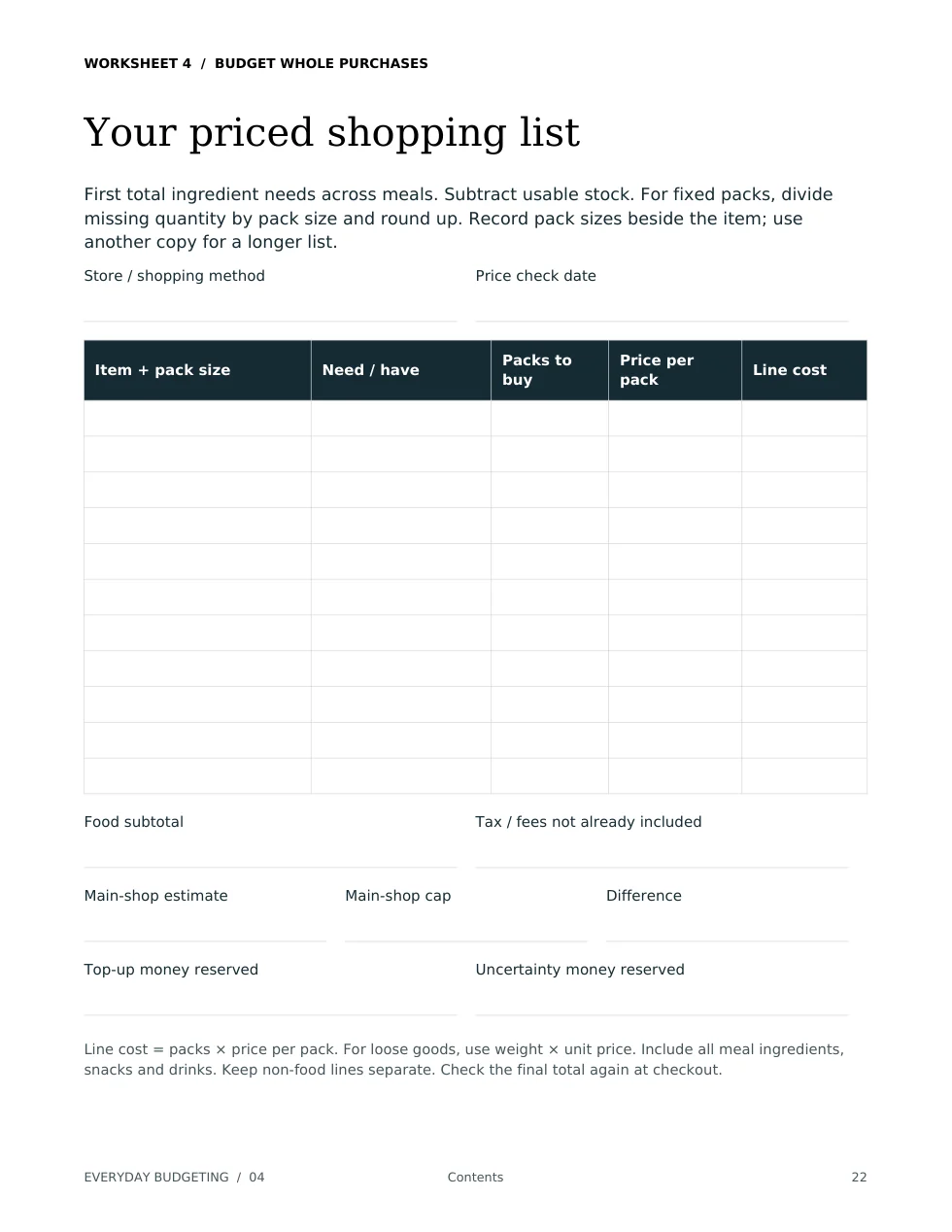
A recipe may use half a pack, but checkout charges for the full pack. Build the shopping estimate from purchase quantities and local prices. Leave a separate allowance for plausible top-ups rather than assuming none will happen.
Unit prices help compare different pack sizes, but a lower price per unit can still require more cash today. Check whether you can store and use the quantity before buying a bulk offer. Include any fee required to reach a delivery threshold in the comparison.
Review one difference after each shop
Write down planned and actual spending for the whole period. Was the difference a price change, an omitted ingredient, an unplanned purchase or food bought twice? Choose one concrete adjustment for the next cycle.
For example, reserve a top-up amount explicitly if milk and fruit run out midweek, or revise meal coverage if the plan assumes cooking on an evening you work late. Repeating this review is more informative than assuming one unusual receipt represents your usual grocery costs.
A worked example
Illustrative totals only; these are not suggested food allowances or local price estimates.
| Part of the cycle | Cost | Cumulative cost |
|---|---|---|
| Main shop | 80 MU | 80 MU |
| Midweek top-up | 15 MU | 95 MU |
| Delivery fee | 5 MU | 100 MU |
A budget of 90 MU is exceeded by 10 MU, even though the main shop stayed below it. Plan and compare all three parts.
Free · No email required
My whole-shop grocery plan
Try the method with your own numbers. This one-page starter is a separate free resource; the complete workbook adds guidance, examples and more worksheets.
Open the printable worksheet ↗Print on paper or choose Save as PDF in your browser’s print menu.
From the actual workbook
See the approach on the page.
This is one selected page from the Grocery Budget Workbook. The free starter above is a separate resource.
 Enlarge page
Sources and scope
The explanation and fictional worked example are published by LearnBudget. These primary resources offer further context; they do not endorse our products.
General financial education, not personalised financial, debt, legal or tax advice. Use one currency consistently and adapt the exercise to your household. Read our editorial approach.