Budget foundations
How to Create a Realistic Monthly Budget
The practical answer
A realistic monthly budget starts with usable income and actual spending records, includes predictable irregular costs, and leaves only genuinely uncommitted money for further decisions. After the monthly totals balance, check the dates of income and bills. Review the plan against what happens rather than treating the first draft as a fixed rule.
Use income your household can allocate
Start with take-home household income, not a gross salary figure that includes deductions. For changing income, distinguish an expected monthly total from money already received. Record which figures are confirmed and which are estimates.
Avoid counting a transfer from your own savings as new earnings. If you plan to draw down savings, label it explicitly so you can see that the plan uses an existing reserve.
Give every real cost a place
Use statements and receipts to list essential commitments, flexible essentials and other spending. Include small repeated purchases as well as large bills. A category should fit the way your household makes decisions, not an idealised version of your routine.
Set aside a realistic contribution for known irregular costs, based on the deadlines remaining. Annual bills, repairs you already expect and seasonal expenses do not disappear because they are absent from this month's statement.
Read the remainder honestly
Subtract the planned costs from usable income. In the example, the 100 MU remainder is available for another decision only after checking that all relevant costs are included. It is not automatically disposable spending.
If the calculation is negative, identify which estimates or feasible choices could change. Do not force the sheet to balance by entering a food allowance you cannot live on, omitting a required payment or assuming uncertain income will arrive.
Check dates, then compare with actual spending
A positive monthly total can still conceal a shortage before payday. Put the main income and payment dates on a cash map and check the lowest balance. Keep reserved bill money separate from money available for other spending.
At the end of the period, record actual amounts beside the plan. Review the largest differences and update the next budget. This turns the sheet into a repeatable decision process rather than a score of whether you had a perfect month.
A worked example
Fictional amounts, not recommended spending ratios. Categories are illustrative.
| Monthly plan | Amount | Remainder |
|---|---|---|
| Usable income | +2,400 MU | 2,400 MU |
| Fixed commitments | −1,500 MU | 900 MU |
| Flexible essentials | −550 MU | 350 MU |
| Known irregular costs | −150 MU | 200 MU |
| Other planned spending | −100 MU | 100 MU |
100 MU remains to allocate. First check missing costs and payment dates; then decide its job.
Free · No email required
My realistic monthly budget starter
Try the method with your own numbers. This one-page starter is a separate free resource; the complete workbook adds guidance, examples and more worksheets.
Open the printable worksheet ↗Print on paper or choose Save as PDF in your browser’s print menu.
From the actual workbook
See the approach on the page.
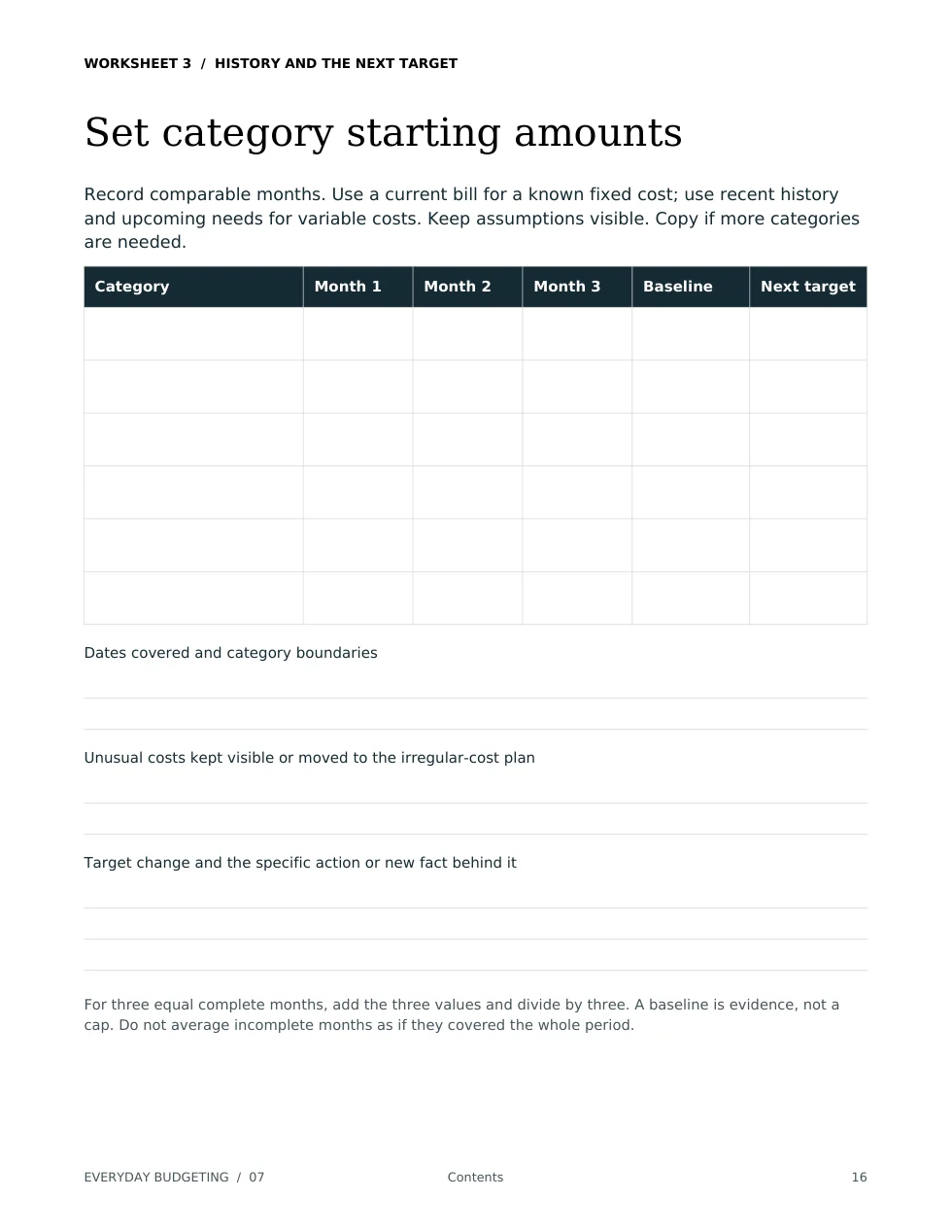
This is one selected page from the Realistic Budget Workbook. The free starter above is a separate resource.
 Enlarge page
Sources and scope
The explanation and fictional worked example are published by LearnBudget. These primary resources offer further context; they do not endorse our products.
General financial education, not personalised financial, debt, legal or tax advice. Use one currency consistently and adapt the exercise to your household. Read our editorial approach.