Plan ahead
How to Save for Annual and Unexpected Bills
The practical answer
For a predictable annual bill, subtract money already reserved from the expected bill, then divide the remaining amount by the paydays left before it is due. Check that the contribution fits your cash flow. Truly unforeseen costs need a separate emergency plan; an annual renewal is an irregular expense even when it feels unexpected.
Look through a full year of costs
Use statements, renewal notices and a calendar to list costs that do not arrive every month. Examples include insurance renewals, seasonal travel, maintenance and school expenses. Label estimates so you can replace them with actual quotes later.
Write the expected due date beside each amount. A calendar turns a vague intention to save into a deadline. Keep an emergency reserve separate from money earmarked for a known bill.
Count the contributions you can actually make
Dividing an annual bill by twelve works only when you have twelve monthly contributions available. If the deadline is closer, use the actual remaining contribution dates. Exclude a payday if the bill must be paid before the money is available.
Subtract the reserve already funded first. A target of 600 MU with 120 MU saved leaves 480 MU to find. With four contributions remaining, the required contribution is 120 MU each, not 50 MU.
Check competing targets against capacity
Add all proposed contributions and compare the total with money available after essential costs. A mathematically correct target is not automatically affordable. If it does not fit, revisit the amount or timing where possible and find out what options the provider actually offers.
When the amount is uncertain, record the evidence behind the estimate and a date to check it again. Do not silently use emergency savings to make every target appear funded; that would hide the tradeoff.
Track reserves without counting them twice
Record each real contribution and update the remaining target. Money moved between your own accounts has not increased your income. It has changed where existing money is held or what it is reserved for.
When the bill is paid, reduce both the reserve record and the account balance in the right place. Review missed contributions or a changed quote promptly. The worksheet is a planning record, so it should reflect what is funded rather than what you hoped to save.
A worked example
Fictional amounts. All four contribution dates occur before the bill is payable.
| Step | Calculation | Result |
|---|---|---|
| Expected renewal | Bill estimate | 600 MU |
| Already reserved | Funded cash | 120 MU |
| Still needed | 600 − 120 | 480 MU |
| Contribution per payday | 480 ÷ 4 | 120 MU |
Four contributions of 120 MU plus the existing 120 MU fund the 600 MU bill. If 120 MU does not fit each payday, the plan needs a feasible adjustment.
Free · No email required
My irregular bill funding plan
Try the method with your own numbers. This one-page starter is a separate free resource; the complete workbook adds guidance, examples and more worksheets.
Open the printable worksheet ↗Print on paper or choose Save as PDF in your browser’s print menu.
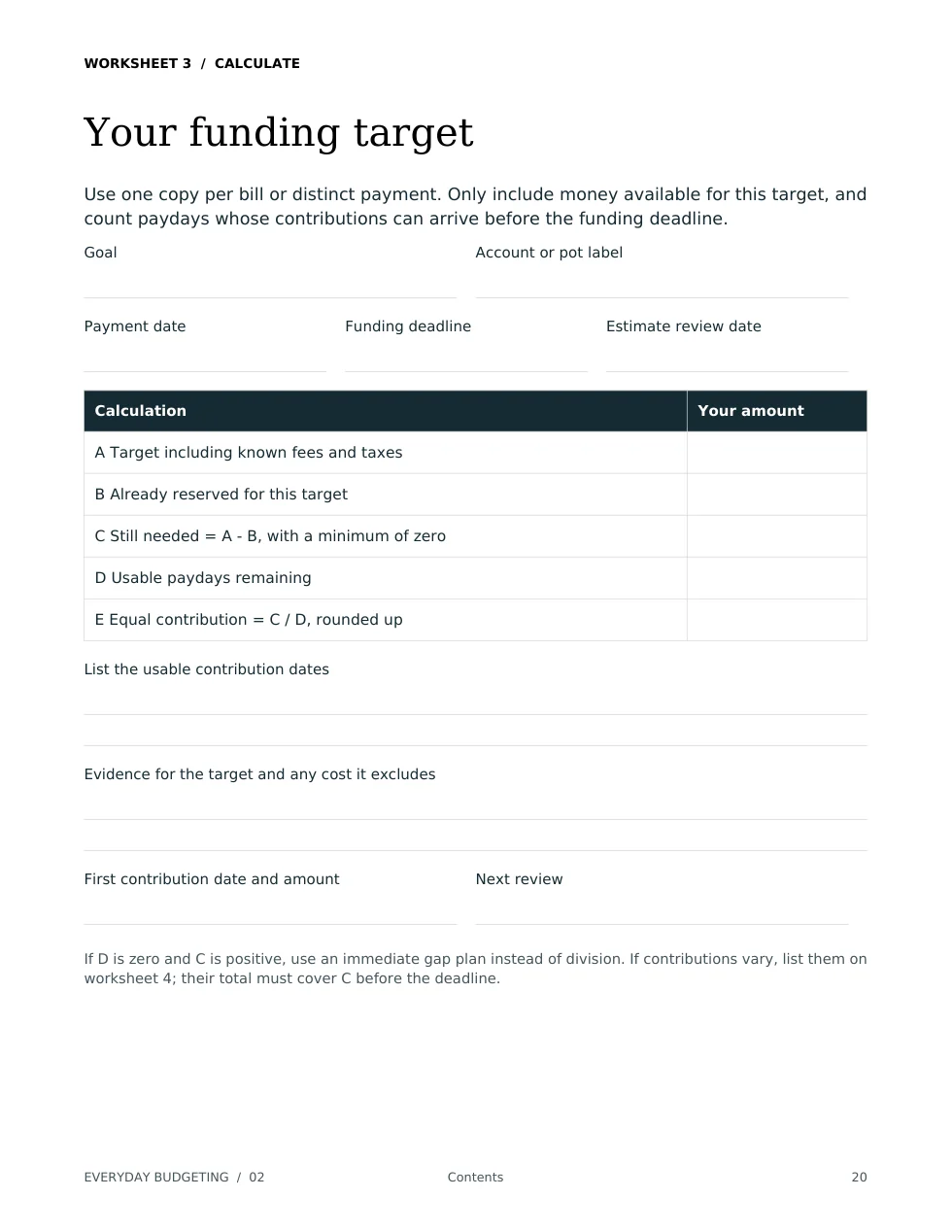
From the actual workbook
See the approach on the page.
This is one selected page from the Irregular Bills Workbook. The free starter above is a separate resource.
 Enlarge page
Sources and scope
The explanation and fictional worked example are published by LearnBudget. These primary resources offer further context; they do not endorse our products.
General financial education, not personalised financial, debt, legal or tax advice. Use one currency consistently and adapt the exercise to your household. Read our editorial approach.