Paydays & cash flow
Why Do I Run Out of Money Before Payday?
The practical answer
A monthly budget can balance overall while individual bill dates leave you short before payday. Write down when money actually arrives and leaves, then calculate the running balance after each payment. A negative balance shows the date and size of the timing gap. If total income is below essential costs, there is also an overall shortfall to address.
Start with money that is really available
Check your bank records and pending transactions. Your displayed balance may include money already committed to a payment that has not cleared. Record those commitments once; do not subtract a pending payment again if it is already reflected in the available balance.
Keep money reserved for another bill separate from money you can spend today. A positive bank balance alone does not tell you how much is available for groceries or travel before your next payday.
Put income and payments in date order
List the next two income dates and the essential payments between them. Use expected arrival dates rather than an average monthly income figure. Mark uncertain receipts clearly and test what happens if they arrive late.
After each row, add money in and subtract money out. Include everyday costs as well as large bills. The lowest running balance tells you more about a payday gap than the balance at the end of the month.
Test one change before relying on it
In the example below, Wednesday creates the problem. Friday's pay cannot cover Wednesday's bill unless a workable change is agreed first. Ask the provider whether a different payment date is available and what it would cost; treat the original date as binding until the provider confirms a change.
Another option might be reducing a flexible cost before the gap or using genuinely available savings. Moving a bill is not extra income. Recalculate the following pay cycle so the change does not simply move the shortage into next week.
Review the plan at the next payday
Compare planned dates and amounts with what happened. Update late income, changed bills and actual spending. Only describe a cushion as funded when the money is already there.
If essential costs exceed income even after realistic changes, a calendar cannot close the gap. Contact providers early about available options and consider an appropriate local nonprofit money-advice service. This exercise is a household planning tool, not a guarantee that every payment can be covered.
A worked example
Fictional money units (MU). The plan finishes positive but first drops below zero.
| When | Movement | Running balance |
|---|---|---|
| Monday | Starting available cash: 300 MU | 300 MU |
| Wednesday | Bill paid: −400 MU | −100 MU |
| Friday | Pay received: +900 MU | 800 MU |
The 800 MU closing balance hides a 100 MU Wednesday shortfall. Identify a feasible change before the bill is due.
Free · No email required
My next-payday cash map
Try the method with your own numbers. This one-page starter is a separate free resource; the complete workbook adds guidance, examples and more worksheets.
Open the printable worksheet ↗Print on paper or choose Save as PDF in your browser’s print menu.
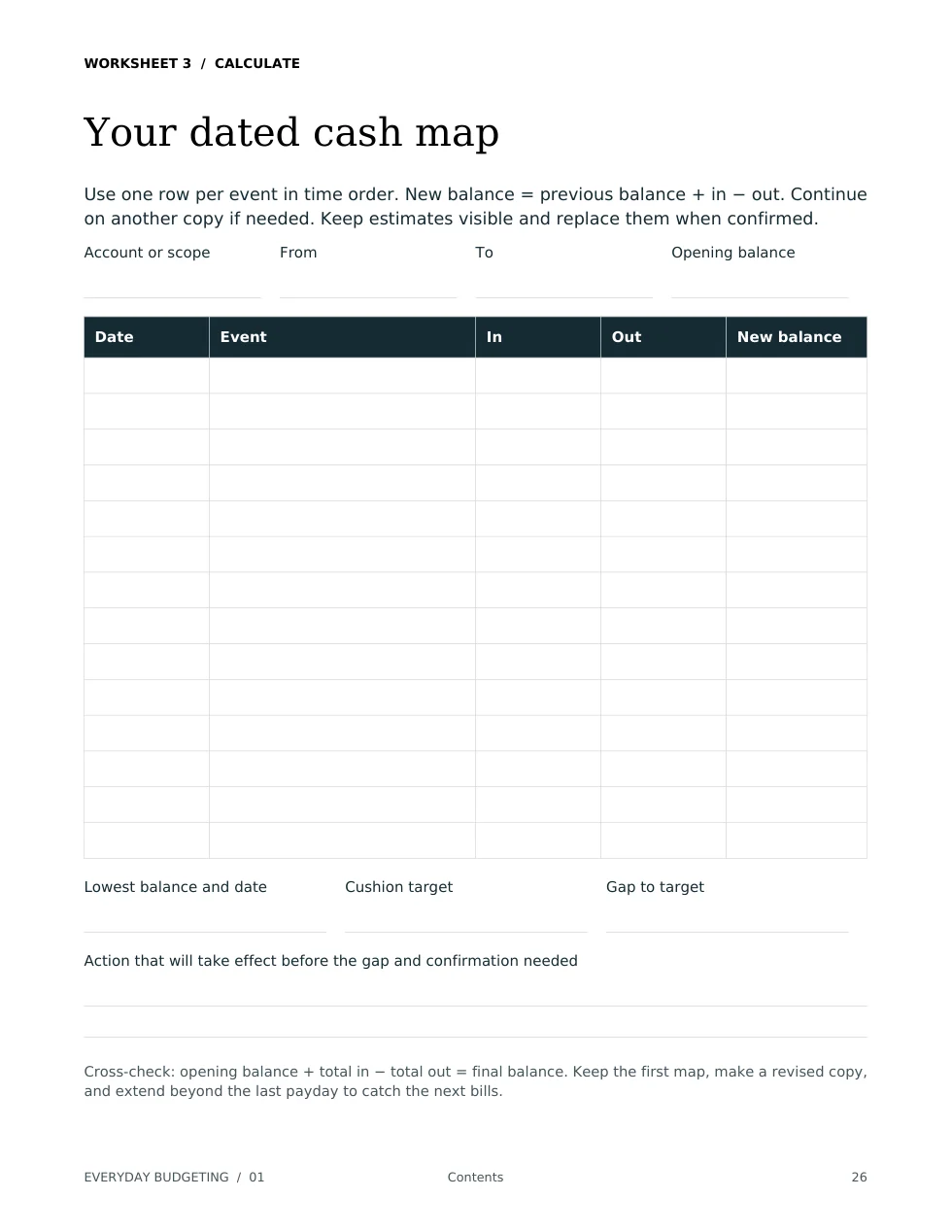
From the actual workbook
See the approach on the page.
This is one selected page from the Payday Cash Flow Workbook. The free starter above is a separate resource.
 Enlarge page
Sources and scope
The explanation and fictional worked example are published by LearnBudget. These primary resources offer further context; they do not endorse our products.
General financial education, not personalised financial, debt, legal or tax advice. Use one currency consistently and adapt the exercise to your household. Read our editorial approach.