Changing income
How to Budget With an Irregular Income
The practical answer
Budget with irregular income by separating money already received from payments you expect. Build a minimum household plan, check essential due dates, and assign each received payment to the next unfunded costs. Test a lower or later payment before committing the remaining money to flexible spending.
Build a minimum household plan from records
List the costs your household needs to cover: housing, essential utilities, adequate food, necessary transport and required payments. Include predictable costs that arrive less often, rather than treating every renewal as a surprise.
Review several past pay periods to understand variation. An average can describe your history, but it does not promise the next payment. Write down a lower-income scenario and which payments would need attention first if it happened.
Keep expected income in a separate column
An invoice, booked shift or promised contribution is useful for forecasting. It is not available cash until you receive it. Record the expected amount, likely date and uncertainty separately from your funded plan.
For freelance work, separate household money from business costs and any tax provision appropriate to your circumstances. This guide does not calculate tax or replace business accounts. Use the amount you can actually allocate to household costs.
Give a received payment a job
Look at what must be paid before the next plausible receipt. Subtract the amounts already funded. Assign the new money to the remaining commitments, then test any flexible spending against that dated plan.
The example keeps 300 MU unallocated after covering the listed costs. That is a decision still to make, not a recommendation to spend it. Check later essential costs and uncertainty before deciding whether to hold it as a buffer.
Test a late payment and review each receipt
Move the next expected receipt a week later on your cash map. Which cost becomes unfunded? Identify what can realistically change, and get provider confirmation before relying on a changed payment date.
A high-income month can help fund later commitments, but avoid counting the same cash as both a bill reserve and an income buffer. Reconcile the allocation record with your actual account balance whenever new money arrives.
A worked example
A household receives 1,200 MU. These are illustrative commitments before its next expected receipt.
| Allocation | Amount | Money left to assign |
|---|---|---|
| Received household money | +1,200 MU | 1,200 MU |
| Housing commitment | −650 MU | 550 MU |
| Food and necessary travel | −180 MU | 370 MU |
| Upcoming essential bill | −70 MU | 300 MU |
The remaining 300 MU is still unallocated. Check later commitments and a lower or delayed next payment before treating it as spendable.
Free · No email required
My received-payment allocation
Try the method with your own numbers. This one-page starter is a separate free resource; the complete workbook adds guidance, examples and more worksheets.
Open the printable worksheet ↗Print on paper or choose Save as PDF in your browser’s print menu.
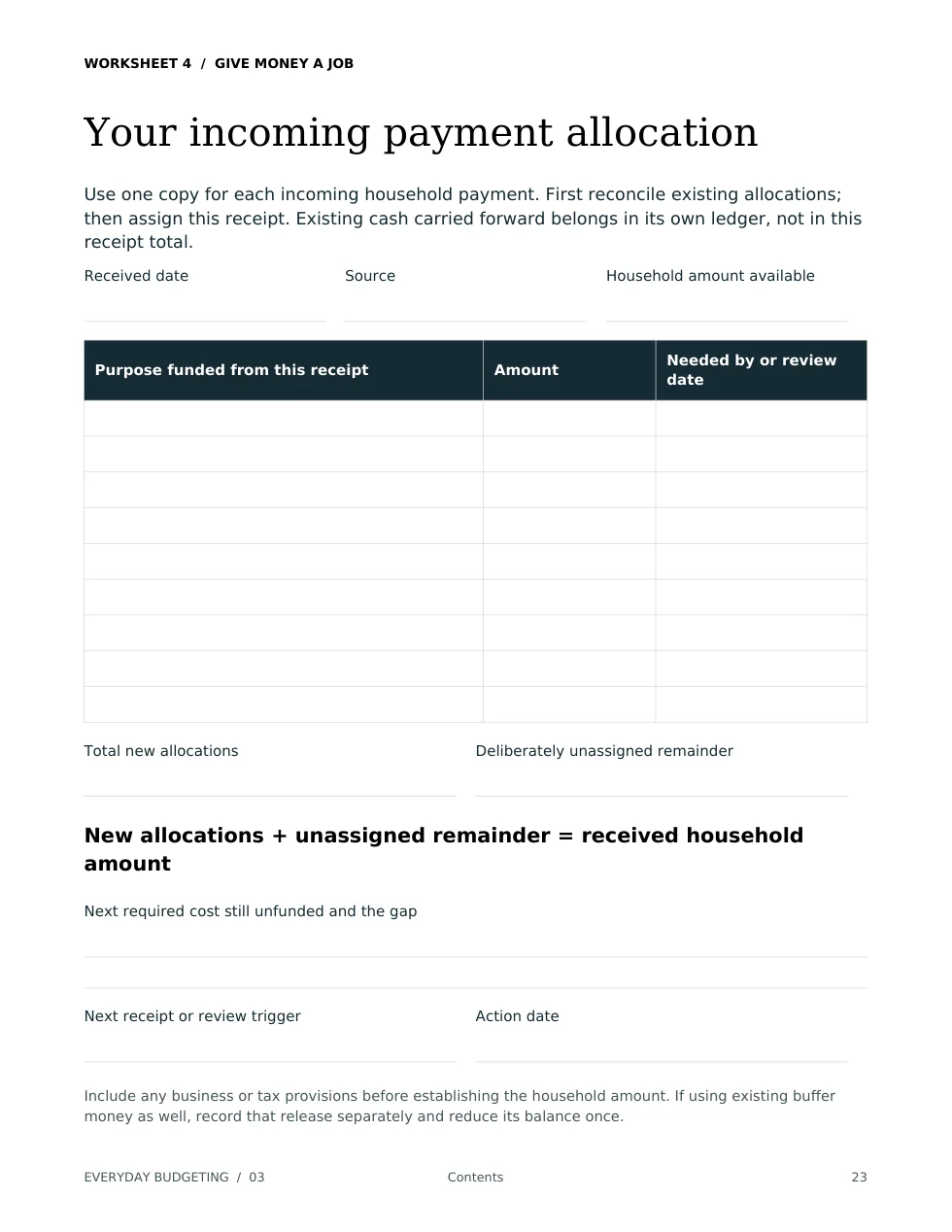
From the actual workbook
See the approach on the page.
This is one selected page from the Variable Income Workbook. The free starter above is a separate resource.
 Enlarge page
Sources and scope
The explanation and fictional worked example are published by LearnBudget. These primary resources offer further context; they do not endorse our products.
General financial education, not personalised financial, debt, legal or tax advice. Use one currency consistently and adapt the exercise to your household. Read our editorial approach.