Emergency savings
How Much Should You Save in an Emergency Fund?
The practical answer
There is no single emergency fund amount that fits every household. Start with a specific unexpected cost you want to cover, look at your income stability and essential expenses, and choose contributions that fit current cash flow. A first milestone can be smaller than a longer-term reserve. Keep known annual bills separate so the same money is not promised twice.
Decide what the reserve is for
Write down the kinds of unplanned costs or income interruptions the reserve should help with. Use your own past experience and current responsibilities. An annual renewal with a known date belongs in an irregular bills plan, even if you have not started saving for it yet.
Separating the two purposes makes the balance easier to interpret. If the same 200 MU is assigned to an annual bill and an emergency, neither target is fully funded.
Choose a first milestone with a reason
The Consumer Financial Protection Bureau explains that the right amount depends on your situation and the unexpected costs you have experienced. Use that starting point rather than assuming one standard amount is right for everyone.
Name a first milestone and what it could help cover. Then think about a larger reserve for other risks, such as a longer loss of income. Essential monthly costs, income reliability and access to other support affect that later decision; the example below is not a recommended target.
Test the contribution against this payday
Work out what you can contribute after current essential commitments and known reserves. A savings transfer that leaves an essential bill unfunded does not solve the underlying cash-flow problem. If nothing fits this period, record that honestly and review when circumstances change.
In the example, a 300 MU first milestone with 100 MU already saved leaves 200 MU to fund. Eight affordable contributions of 25 MU would close that gap, assuming the reserve is not used and no extra costs occur.
Set a use rule and a rebuilding plan
Write down how you will decide whether a cost is unexpected, necessary and within the purpose you chose. Keep the money accessible for that purpose without confusing it with daily spending. The worksheet does not select a bank product or assess local deposit protection.
After using the reserve, record the new balance and recalculate the amount still needed. An emergency fund is meant to be used for its purpose. Review the target as household costs, responsibilities and income change rather than treating a milestone as permanent protection against every risk.
A worked example
These numbers demonstrate the calculation. They are not a recommended emergency fund size.
| Step | Calculation | Result |
|---|---|---|
| Chosen first milestone | Household's example target | 300 MU |
| Already saved for this purpose | Funded reserve | 100 MU |
| Still to fund | 300 − 100 | 200 MU |
| Eight contributions | 200 ÷ 8 | 25 MU each |
At 25 MU per contribution, eight contributions reach 300 MU from 100 MU, provided there are no withdrawals. Check affordability and review the next milestone separately.
Free · No email required
My emergency savings first milestone
Try the method with your own numbers. This one-page starter is a separate free resource; the complete workbook adds guidance, examples and more worksheets.
Open the printable worksheet ↗Print on paper or choose Save as PDF in your browser’s print menu.
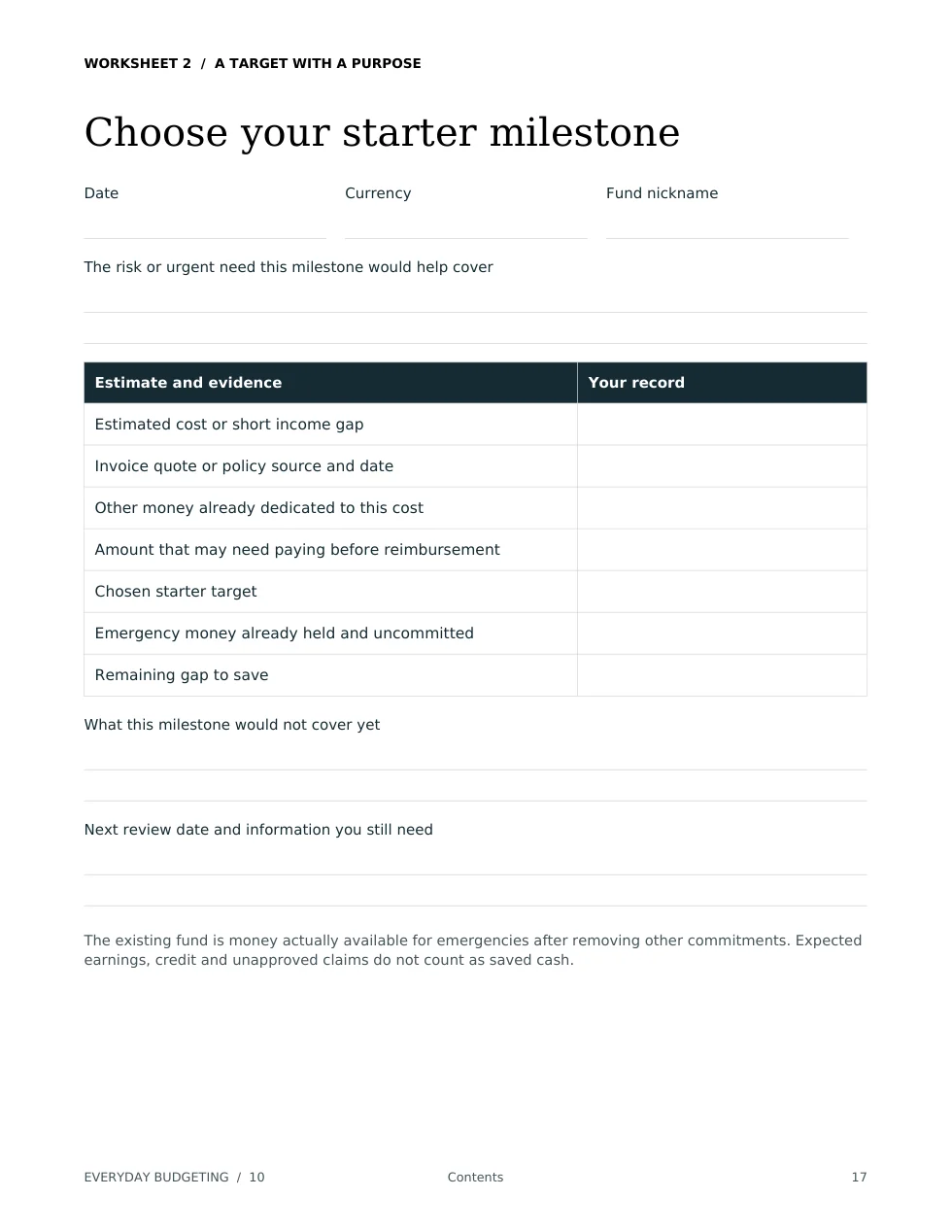
From the actual workbook
See the approach on the page.
This is one selected page from the Emergency Fund Workbook. The free starter above is a separate resource.
 Enlarge page
Sources and scope
The explanation and fictional worked example are published by LearnBudget. These primary resources offer further context; they do not endorse our products.
General financial education, not personalised financial, debt, legal or tax advice. Use one currency consistently and adapt the exercise to your household. Read our editorial approach.